
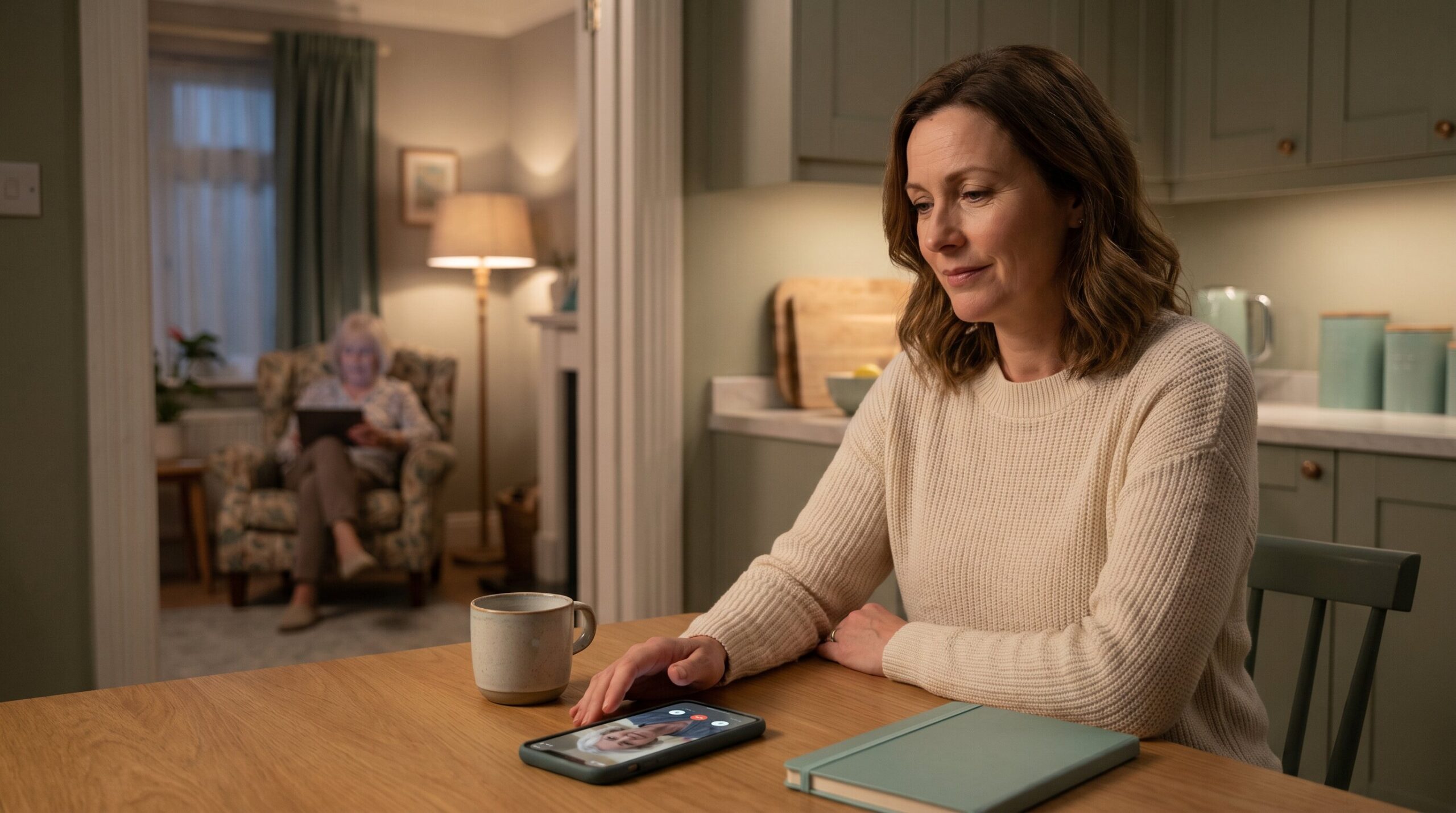
Caring from a distance often feels like carrying a question all day
If you help care for an aging parent from a few hours away, you probably know the feeling. You are in a meeting, making dinner, driving your kids somewhere, or trying to get through your own day, and one question keeps coming back: “Is Mom okay today?”
Long-distance caregiving can be emotionally heavy because the hardest part is often not the tasks themselves. It is the uncertainty. Did she get up? Did she eat? Did something change? Is she saying she is fine because she truly is, or because she does not want anyone to worry?
This is becoming a more common reality for families. AARP reports that more than 10 percent of caregivers live an hour or more away from the person they support, and it describes long-distance caregiving as one of the fastest growing forms of caregiving (AARP).
The goal is not to take over your parent’s life. For many families, the goal is simpler and more emotional: help Mom or Dad stay at home for as long as possible, while knowing when something may be changing.
Start by looking for patterns, not perfection
When you are caring from a distance, it is easy to react to single moments. One missed call can trigger panic. One quiet day can make you wonder if something is wrong. One unusual comment can stay with you all afternoon.
But one moment does not always tell the full story. What matters more is the pattern.
A parent might miss one meal because they were not hungry. That is different from meals being skipped more often. They might forget one call because they were busy. That is different from a routine that suddenly becomes inconsistent. They might have one low-energy day. That is different from a noticeable shift in movement, mood, or daily habits.
When you are not nearby, watching for patterns can help you move from constant guessing to more thoughtful support.
Small changes worth paying attention to
Here are a few signs that may be worth noticing, especially when they happen more than once or begin to form a pattern.
Changes in meals or nutrition
If your parent is eating less often, leaving groceries unused, skipping regular meals, or relying more on snacks, it may be a sign that daily routines are becoming harder to maintain.
This does not always mean something urgent is happening. It may mean they are tired, less mobile, forgetting, or finding meal preparation more difficult than before.
Less movement around the home
Aging parents may naturally slow down over time, but sudden or repeated changes in activity can matter. Less movement may point to fatigue, pain, fear of falling, low mood, illness, or a change in confidence.
If your parent is spending more time in one area of the home, avoiding stairs, skipping usual routines, or seeming less active than normal, it may be time to ask more questions.
Missed medications or appointments
Medication routines can become harder to manage, especially when there are multiple prescriptions, changing instructions, or appointments with different providers.
The National Institute on Aging includes health care support, medications, transportation, personal care, meals, household chores, and safety as common areas where older adults may need help to keep living at home (National Institute on Aging).
If missed medications or appointments become a pattern, it may be time to add reminders, local support, or a more structured care plan.
Calls going unanswered more often
Every family has its own rhythm. Some parents answer every call. Others rarely pick up the phone. The key is not whether they miss a call once. The key is whether communication changes from what is normal for them.
If calls are going unanswered more often, texts are not being returned, or your parent seems harder to reach during times they are usually available, it is worth paying attention.
A home routine that feels different
Sometimes the signs are subtle. The house looks a little less organized. Laundry piles up. The fridge is emptier than usual. A parent who used to keep a steady routine seems less consistent.
These small changes can be easy to miss when you live nearby. They can be even harder to notice from a few hours away.
Build a support circle before there is a crisis
Long-distance caregiving works better when you are not the only person trying to notice everything.
AARP recommends building a local support network that may include professionals such as doctors, attorneys, accountants, therapists, and specialty providers, as well as informal supports such as family, neighbors, and community connections (AARP).
That support circle might include:
- A nearby sibling, relative, or trusted friend
- A neighbor who can check in occasionally
- A pharmacy contact
- A family doctor or clinic contact
- A local home care provider
- A community senior support organization
- A care manager, if the situation is becoming more complex
The National Institute on Aging also recommends planning before a lot of care is needed, learning what services are available in the community, and revisiting support decisions as needs change over time (National Institute on Aging).
Planning early does not mean you are taking independence away. It means you are creating options before stress forces rushed decisions.
Have the conversation before it becomes urgent
Many families wait until there is a fall, missed medication, hospital visit, or major scare before talking about support. That is understandable. These conversations can feel emotional, especially when a parent is proud, private, or afraid that “support” means losing control.
Try not to start with:
“We’re worried about you.”
That can make a parent feel judged, watched, or cornered.
Try something softer:
“We want to help you stay at home as long as possible. Can we talk about what would make that easier?”
Or:
“I know your independence matters. I also want to make sure we notice if you ever need more support.”
The conversation is not about proving that something is wrong. It is about agreeing on how the family will notice changes early and respond with care.
Technology can help, but it should respect dignity
Technology is becoming a bigger part of long-distance caregiving. AARP reports that remote monitoring by caregivers increased from 13 percent in 2020 to 25 percent in 2025 (AARP).
But not every technology feels right for every family.
Some older adults do not want cameras in their home. Some forget to wear or charge a device. Some do not want to feel monitored. And many caregivers do not want their parent’s home to feel like a hospital or surveillance space.
That is why privacy-first support matters.
At LiLo, we believe families should be able to understand meaningful changes at home without asking an aging parent to wear, charge, or carry something, and without placing cameras in private spaces.
The goal is not to watch every moment. The goal is to notice patterns that may help families act sooner, support gently, and protect independence.
A real caregiver said it best
One LiLo user, Tracey W., described the experience this way:
“Caring for my mom from a few hours away hasn’t been easy. I’m always wondering if I’m missing something. She wants to stay in her home as long as she can, and I really want that for her, but trying to balance the distance, my job, and my own life can feel like a lot.
LiLo brought small things to my attention that I probably would have missed. It helped me see when it was time to get her a bit more support.
She still gets to live at home. And I don’t feel like I’m constantly guessing anymore.”
Tracey W., daughter and long-distance caregiver
That is the heart of long-distance caregiving. You want your parent to stay independent. You also want to know when something has changed. You want to help without hovering. You want to care without constantly guessing.
A simple long-distance caregiver check-in checklist
If you are supporting a parent from a distance, use this as a starting point.
Ask yourself:
- Are meals and groceries following a normal pattern?
- Is Mom or Dad moving around the home as usual?
- Are medications and appointments being managed consistently?
- Are calls or texts being answered in a normal rhythm?
- Has mood, energy, or conversation changed recently?
- Does the home look and feel the way it usually does?
- Is there a nearby person who can check in if something feels off?
- Have we talked about what kind of support would feel acceptable?
- Do we have legal, medical, and emergency information organized?
- Are we planning ahead, or waiting for a crisis?
You do not need to solve everything at once. Start with one conversation, one support option, or one pattern you want to understand better.
Final thought
Caring for a parent from a few hours away is not just about distance. It is about uncertainty.
When families can notice small changes earlier, they can make calmer decisions. They can add support before a crisis. They can respect independence while staying connected.
And most importantly, they can help Mom or Dad stay at home with dignity for as long as possible.
If you are caring for an aging parent from a distance, LiLo can help your family understand daily patterns at home without cameras, wearables, or constant check-ins.
Try LiLo free for one month and see if it is the right fit for your family.